
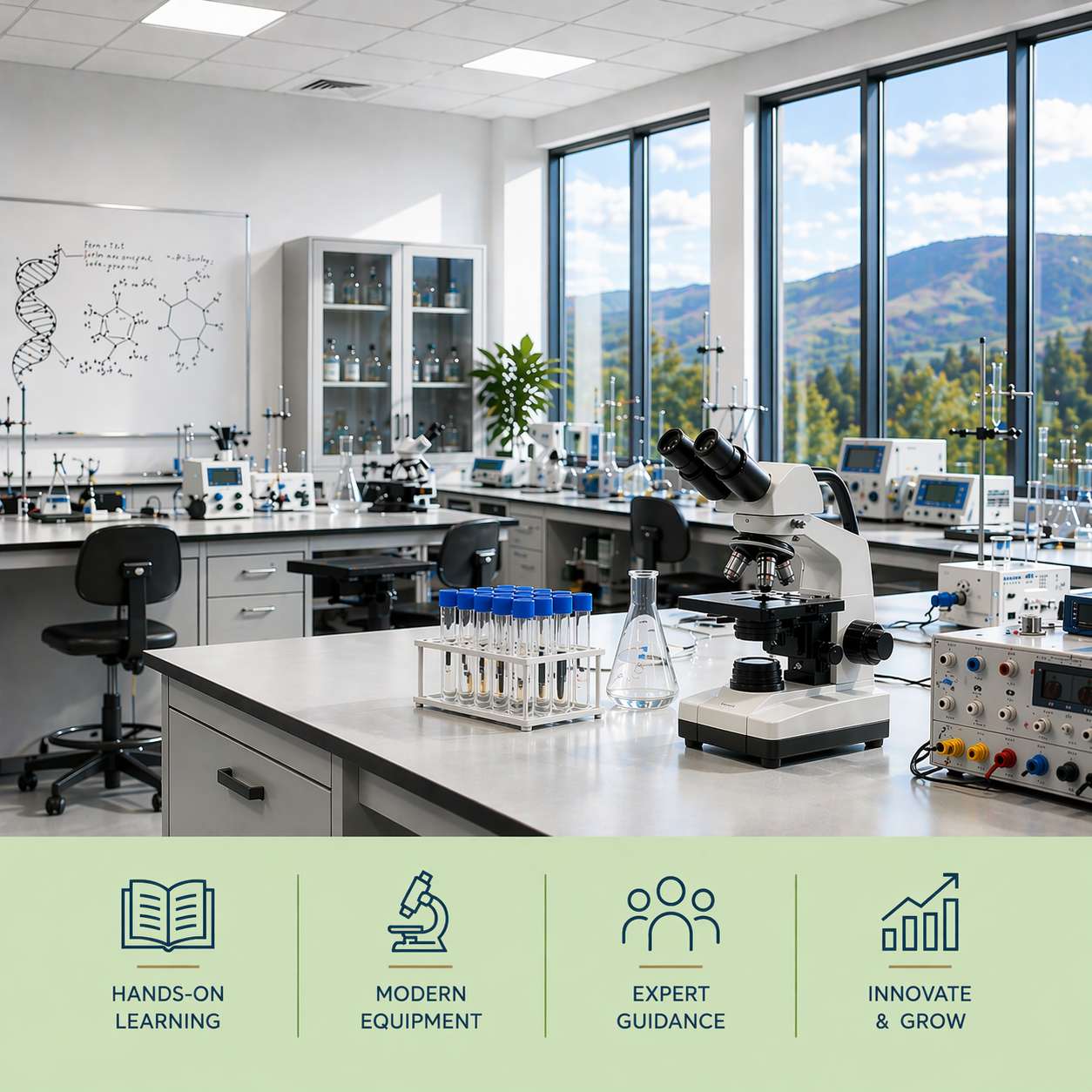
Learning doesn’t stop in the classroom.
In our labs, students test ideas, run experiments, and apply what they learn using modern equipment and real-world scenarios. With expert guidance, they develop the skills and confidence needed for their future careers.
Medicine
The teaching laboratory of the School of Medicine and Health Sciences supports students in engaging in practical activities from an early stage and developing their clinical thinking skills.
In this environment, students not only apply theoretical knowledge but also develop essential skills such as observation, analysis, and drawing conclusions. The teaching process is organized interactively and based on active student participation.
The laboratory offers practical sessions in core medical disciplines such as biochemistry, physiology, microbiology, and histology. Students learn how to use laboratory equipment properly, prepare and analyze samples, conduct experiments, and interpret results.

Robotics
In this lab, students explore how robots work and how they are used in real-world settings. They learn how robotic arms move (joints, axes, degrees of freedom) and how motion and precision are controlled.
Students also gain hands-on experience programming robots using block-based coding, Python, C++, and Arduino. They apply these skills in practical tasks such as pick-and-place, sorting, and basic automation processes.
The lab helps students build confidence in working with modern technologies and develop skills relevant for future careers.

Mechatronics
In this lab, students bring their ideas to life through digital design and fabrication. They create and engrave items such as rulers, keychains, and nameplates based on their own designs.
Students also develop custom learning tools, including geometric shapes, puzzles, and diagrams, while exploring how different materials respond to laser cutting in terms of heat, precision, and durability.
Projects are often completed in teams, where students take on roles such as CAD design, machine setup, assembly, and presentation - building both technical and teamwork skills.

Computer & Programming
In this lab, students learn the fundamentals of programming by writing, compiling, and running code. They explore different programming languages such as Python, C, C++, C#, and Java while developing a strong understanding of syntax, logic, algorithms, and debugging.
Students apply these skills by building small applications and practical projects. They also gain experience working with development environments (IDEs) such as Visual Studio, PyCharm, and Eclipse.
The lab helps students build a solid foundation in software development and prepares them for more advanced study and real-world applications.

Computer & Graphic Design
In this lab, students develop both creative and technical design skills using modern digital tools. They learn to create clear and visually engaging posters, diagrams, and presentations that communicate ideas effectively.
Students also gain practical experience with computer systems and software used for design, data handling, and digital communication. Basic programming is introduced to support problem-solving and simple automation tasks.
Through project-based work, students prepare professional reports, design portfolios, and presentations-building skills that are essential for academic work and future careers.

Physics
Power Supply Units (DC/AC Sources)
Students learn how to safely connect circuits and control different power levels in practical settings.
Measuring Instruments (Voltmeter, Ammeter, Oscilloscope)
These tools help students observe and understand how electrical quantities change during real experiments.
Laboratory Workbenches
Workspaces are designed for small group collaboration. Students build circuits, take measurements, and record and analyze their results.

Chemistry
The Chemistry Teaching Laboratory provides a modern space where students apply theoretical knowledge through hands-on experiments in general, organic, and analytical chemistry.
Using contemporary equipment and working within a safe lab environment, students develop essential skills such as measurement, data analysis, and laboratory reporting.
The lab also prepares future teachers to design and deliver safe, engaging chemistry lessons in school settings.

Biology
The Biology Teaching Laboratory offers an interactive space where students explore living systems through observation and experimentation. It covers key areas such as cell biology, microbiology, ecology, and human physiology.
Students use microscopes and essential lab tools to study specimens and carry out simple experiments. The lab also includes an aquarium setup to support the study of aquatic ecosystems.
A strong focus is placed on developing critical thinking and preparing future teachers to use inquiry-based approaches in the classroom.
